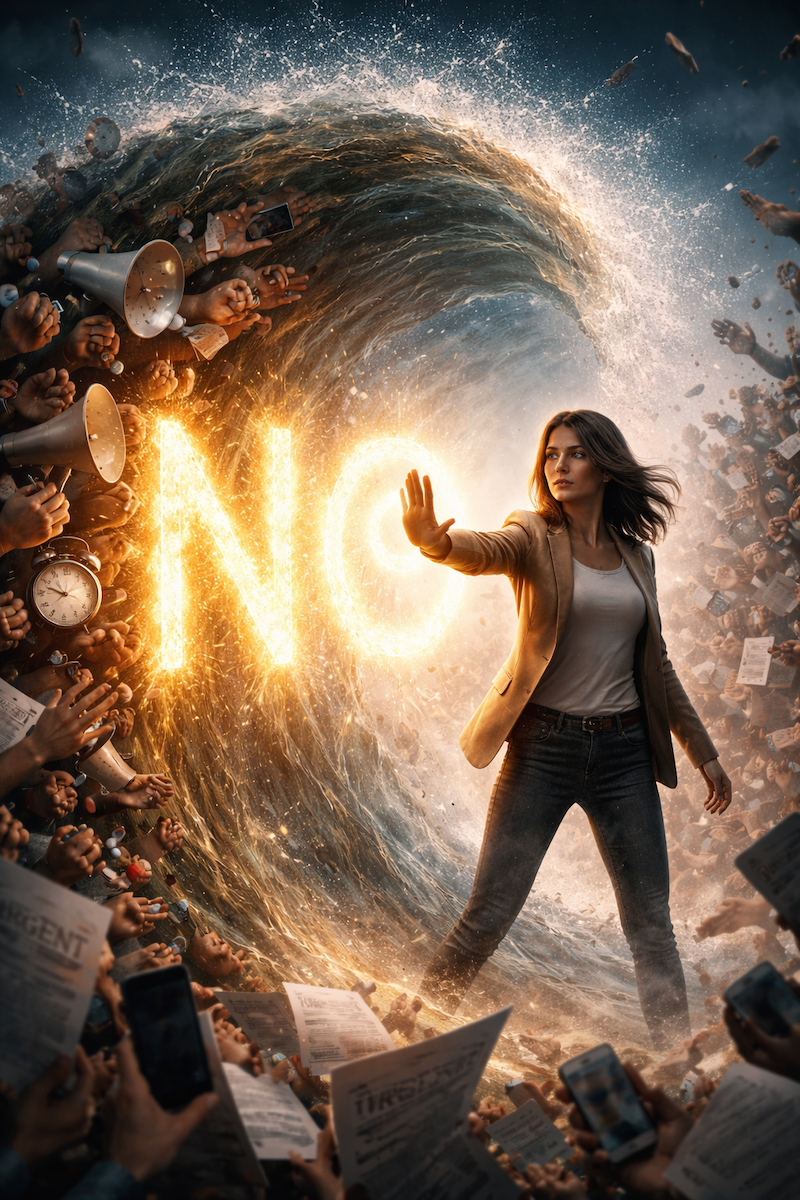
What happens in our brain, body, and emotions when we resist or are refused
Sometimes a single word can change an entire day.
Or a relationship.
Or the way we see ourselves.
“No.”
It is a small word, but behind it lies an entire world of reactions: biological, emotional, and psychological. Most of the time we do not realize how deeply it affects us—whether we are the ones saying it or the ones hearing it.
This article is not about conflict.
It is about boundaries. About courage. And about how our mind and body respond to rejection.
When we say “No” – the brain learns to protect itself
For many people, saying “no” is not easy.
Especially if we were raised to be “nice,” not to disturb others, or to please everyone.
When we say “no,” a part of the brain responsible for decision-making and self-control becomes active. It is almost as if the mind is saying:
“This is where my comfort zone ends. This is where I choose.”
At the same time, a small inner tension may appear. Another part of the brain worries about the consequences:
- What if they get upset?
- What if they reject me?
- What if they stop liking me?
That is why, sometimes, after saying “no,” we feel guilty. Not because we did something wrong, but because our brain is wired to seek social acceptance.
Over time, however, every respectful “no” becomes a form of inner training.
The brain learns that healthy boundaries do not destroy relationships.
They clarify them.
When we hear “No” – the body reacts as if to a wound
Few people know that rejection activates the same areas of the brain as physical pain.
That is why a refusal can hurt… almost like a blow.
When someone says “no” to us, the body may react like this:
- the heart beats faster
- the stomach tightens
- breathing becomes more shallow
- a feeling of shame or sadness may appear
These reactions are very old from an evolutionary perspective.
For our ancestors, being rejected by the group could mean danger to survival. The brain still carries this memory.
But in modern life, most refusals are not real threats.
They are simply boundaries.
What we truly feel when we are refused
Often we simply say: “I was rejected.”
But inside, several emotions appear at the same time:
- disappointment
- frustration
- shame
- sadness
- sometimes anger
The brain quickly tries to find an explanation. And very often it finds the harshest one:
“I’m not good enough.”
“I’m not wanted.”
“I’m not important.”
In reality, rejection much more often reflects the other person’s limits or needs—not our value.
But emotions are not always logical.
They are human.
The quiet power of boundaries
Paradoxically, people who can say “no” calmly are often perceived as more emotionally stable.
Because clear boundaries create safety.
When we know where our personal space begins and ends, relationships become more authentic. We no longer say “yes” out of fear or obligation, but out of choice.
And when someone says “no” to us, we can learn to see it differently:
not as a personal rejection,
but as information about that moment’s reality.
A simple exercise
The next time you hear or say “no,” pause for a moment and notice:
- What is happening in my body?
- What thought appears first?
- What emotion do I feel?
Just observe.
Often, between reaction and understanding there are only a few seconds of attention.
In the end
“No” is not a word that separates people.
It is a word that defines the space between two freedoms.
My freedom.
And yours.
And when we learn to use it with respect—and to receive it without fear—our relationships become more mature, clearer, and, paradoxically, closer.