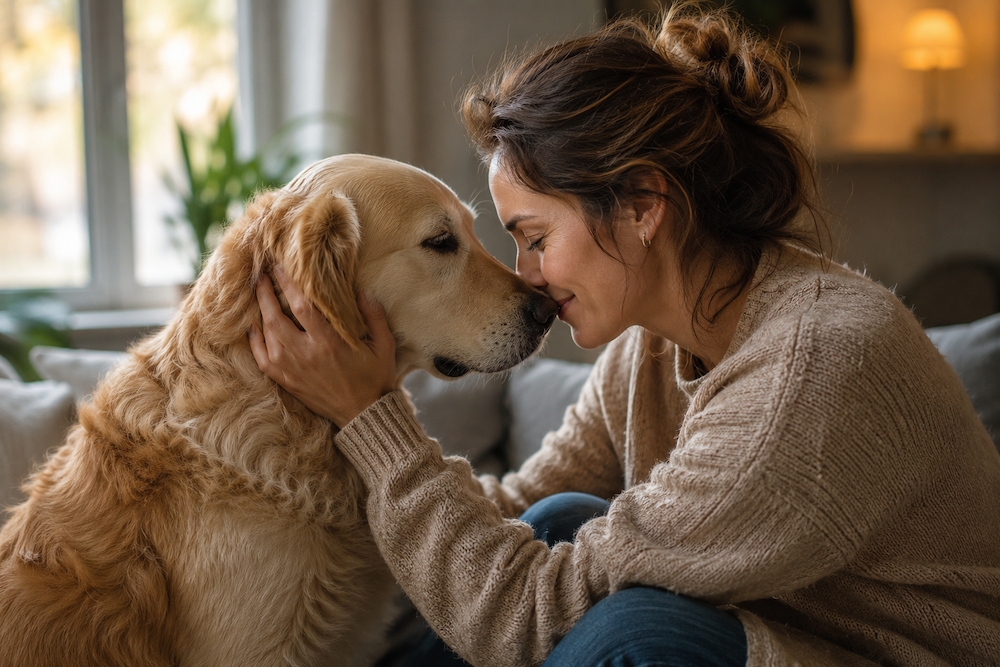
There is something almost paradoxical about the relationship between humans and dogs. On the one hand, they are a different species with their own instincts, needs, and social structures. On the other hand, they seem to understand us in ways that feel remarkably human. Science is now beginning to explain why.
Dogs Are Not Meant to Be Alone
At their core, dogs are social animals. Long periods of solitude are not natural for them. When left alone too often, many dogs show signs of stress, anxiety, or even depressive behavior. This is not “bad behavior” — it is a reflection of their need for social contact, ideally with both humans and other dogs.
In many cases, dogs that live alone also miss interaction with other dogs. Just like humans, they benefit from variety in their social environment.
Leadership, Structure, and Emotional Safety
Dogs naturally look for guidance. This doesn’t mean dominance in a harsh sense, but rather structure and predictability. Clear rules, consistent signals, and calm leadership help dogs feel secure.
What matters most is not just what we say, but how we say it. Tone of voice, posture, and body language are often more powerful than words. A steady, confident presence signals safety and reduces anxiety in dogs.
Inconsistent behavior, on the other hand, creates confusion. A dog does not need perfection — it needs clarity.
Dogs Understand More Than We Think
Dogs are surprisingly skilled at reading human communication, especially gestures. One of the most fascinating examples is the human pointing gesture.
While many young children and animals initially struggle to understand that a finger can refer to something distant, dogs learn this remarkably well. In experiments, dogs consistently follow a pointing gesture toward hidden food or objects — even outperforming many other species in interpreting human cues.
However, they also learn from experience whom to trust. In studies where humans intentionally pointed incorrectly, dogs quickly stopped following unreliable signals. Interestingly, they could also distinguish between different people and adjust their behavior based on past reliability.
This suggests that dogs are not just reacting — they are evaluating social trust.
The Chemistry of Attachment: Oxytocin
One of the most important discoveries in human-dog relationships is the role of bonding hormones. In particular, Oxytocin plays a key role.
Oxytocin is often called the “bonding hormone” because it increases during moments of closeness — between parents and children, romantic partners, friends, and also between humans and dogs.
When a person interacts with a dog they are bonded to — through touch, eye contact, or calm presence — oxytocin levels rise in both species. This creates a feedback loop of trust, calmness, and emotional connection.
Eye contact, in particular, is fascinating. While sustained eye contact can feel intense or even threatening in many animal species, dogs have evolved to tolerate and even seek human gaze. Over time, this mutual gaze strengthens emotional bonding.
Dogs and Human Emotional Patterns
Research on attachment suggests that the emotional dynamics between humans and dogs often mirror human relationships.
Dogs can develop anxiety when separation from their owner is frequent or unpredictable. Similarly, owners who struggle with attachment or emotional availability may unintentionally create insecurity in their dogs.
But the reverse is also true: dogs can provide a stable, secure emotional presence for humans. They do not judge, compare, or demand performance. Their attachment is often consistent and unconditional.
This stability can have a grounding effect on human emotional life.
Health, Stress, and Well-being
The benefits of living with dogs extend beyond emotional comfort.
Studies show that dog owners often experience:
- Lower stress levels
- Reduced blood pressure
- Improved physical activity (thanks to daily walks)
- Better sleep quality
- Faster recovery after illness or cardiac events
Part of this is behavioral — dogs encourage movement and routine. But part of it is biological. Reduced stress and increased oxytocin contribute directly to physical health.
Dogs as Social Bridges
Another overlooked benefit of dogs is their role in human social life. People are more likely to interact with strangers when a dog is present. Dogs act as social “ice-breakers,” making human contact easier and more natural.
This challenges the idea that people turn to pets because they withdraw from human relationships. In reality, strong human relationships and strong human-animal bonds often reinforce each other rather than compete.
A Relationship Without Conditions
Perhaps the most profound aspect of the human-dog bond is its simplicity.
Dogs do not require us to be impressive, successful, or perfect. They do not evaluate us by achievements or appearance. They respond to presence, consistency, and care.
This makes the relationship unusually light and emotionally free. A dog’s attachment is rooted in “being together,” not “being enough.”
And in a world where human relationships are often complex and conditional, this simplicity can feel deeply restorative.
The relationship between humans and dogs is not a one-sided dependency. It is a co-evolved partnership shaped by biology, behavior, and shared emotional chemistry.
We influence dogs. Dogs influence us. And somewhere in between, we have created one of the most unique interspecies relationships on Earth — one that improves not only our emotional lives, but also our physical health and social well-being.