I’ve noticed something about myself.
On some days, I open my phone for no clear reason. I’m not looking for anything in particular. And yet, after a few minutes of scrolling, I feel different. More tired. Smaller. More restless. As if someone had whispered to me, without words: you are not enough.
It’s not people who do this.
Algorithms do.
Invisible, silent, extremely efficient.
The Algorithm Doesn’t Know Me, But It “Senses” Me
The algorithm doesn’t know who I am. It doesn’t know what I’ve been through. It doesn’t know what pain or hope I carry inside. And yet, it seems to know exactly where to press.
If I pause one second longer on a video about success, I receive ten more.
If I like a story about failure, I get confirmations that the world is unfair.
If I enter a state of comparison, the algorithm offers me the perfect showcase for it.
Truth doesn’t matter.
My reaction does.
And without meaning to, I end up living inside a version of reality built from my most sensitive fragments.
The Lies That Don’t Hurt Immediately
Today’s lies are not aggressive. They are seductive.
They come in forms like:
“This is what your life should look like.”
“If you had worked hard enough, you’d already be there.”
“Everyone else is doing better.”
I don’t reject them. I let them pass through me.
And each one leaves a small trace.
Not a visible wound.
But a crack.
And cracks, gathered over time, change the way I see myself.
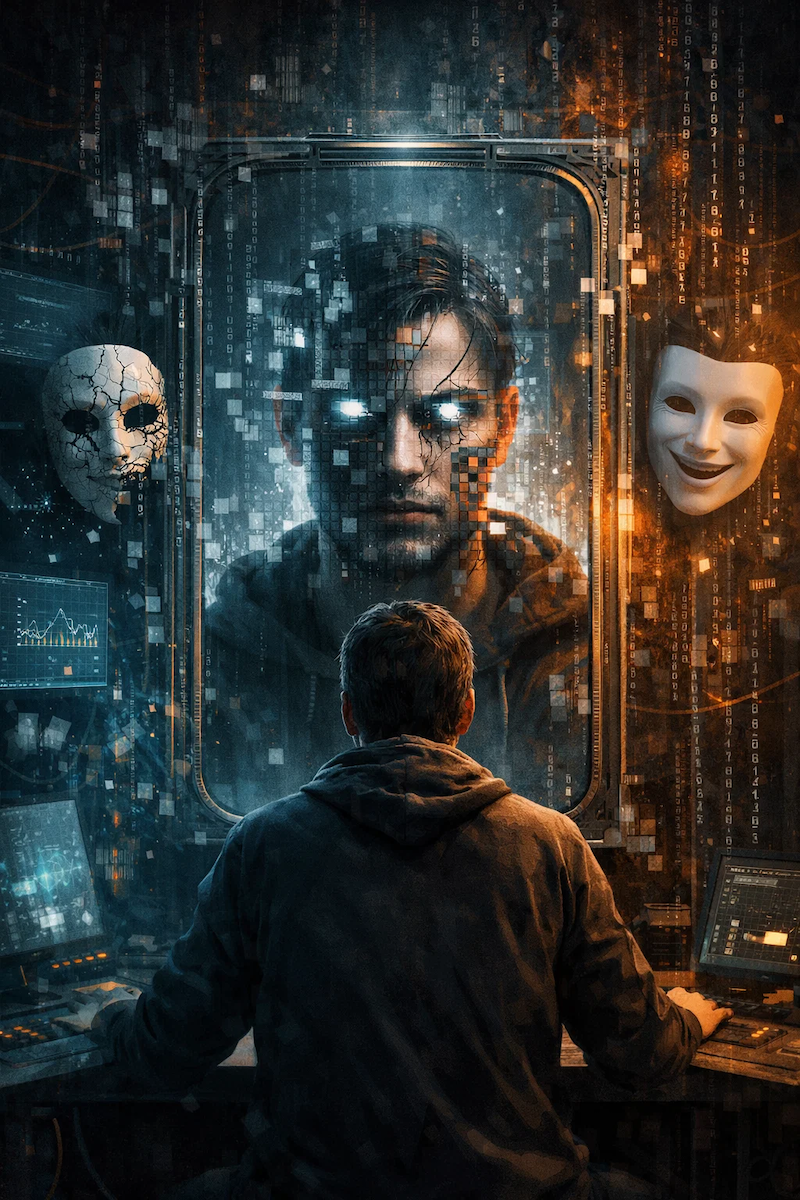
The Mirror That Doesn’t Tell the Whole Truth
Social media is a mirror. But not an honest one.
It shows me only parts of myself:
the part that reacts,
the part that compares,
the part that wants more, faster, better.
It doesn’t show me stillness.
It doesn’t show me the small, real moments.
It doesn’t show me the slow processes.
And then the confusion appears: Is this who I am?
Or just a version of me reflected in a system that lives off my emotions?
When I Start Playing by Their Rules
At some point, I notice the temptation:
to say what works,
to post what gets validated,
to avoid what is too deep, too slow, too true.
And this is where it becomes dangerous.
Because the algorithm doesn’t steal our identity.
We adjust it ourselves, step by step, so we don’t disappear from the feed.
A Pause. A Breath. A Choice.
I’ve started asking myself:
What am I feeding when I scroll?
What emotions am I training daily?
Which part of me is being “seen” constantly?
Because the algorithm doesn’t create from nothing.
It amplifies what I offer.
And maybe this is the only place where I truly have power.
A Question I Often Ask Myself
If my feed were a letter from my psyche, what would it tell me?
That I’m tired?
That I need validation?
That I’m afraid to sit with myself in silence?
Maybe the virtual mirror isn’t just manipulation.
Maybe it’s also a signal.
Not one to be believed blindly.
But one to be read with discernment.
Instead of a Conclusion
I don’t want to run away from technology.
I just don’t want to confuse myself with its reflection.
My truth is not in likes.
It’s not in reach.
It’s not in what “performs well.”
It lives in the moments when I close the app and return to myself.
To my rhythm.
To my real, imperfect, alive life.
And that, no matter how advanced the algorithm becomes, cannot be copied.
Reflection Exercise: Your Digital Mirror
Take 5–10 minutes, without your phone, without distractions.
Think about the last time you felt a strong wave of emotion while browsing online—anger, envy, anxiety, or even admiration.
Write in a journal:
- What exactly triggered this emotion?
- Which part of you resonated with it?
- How did you react?
Ask yourself: Does my feed reflect who I really am, or who “resonates” most with me?
Note one small, concrete step you can take to recalibrate your relationship with technology and your own reflection—maybe limiting social media time, posting more mindfully, or creating quiet offline moments.
💭 Purpose: to see your feed not as a mirror of your worth, but as a signal—an indicator of emotions and vulnerabilities that deserve to be understood, not judged.