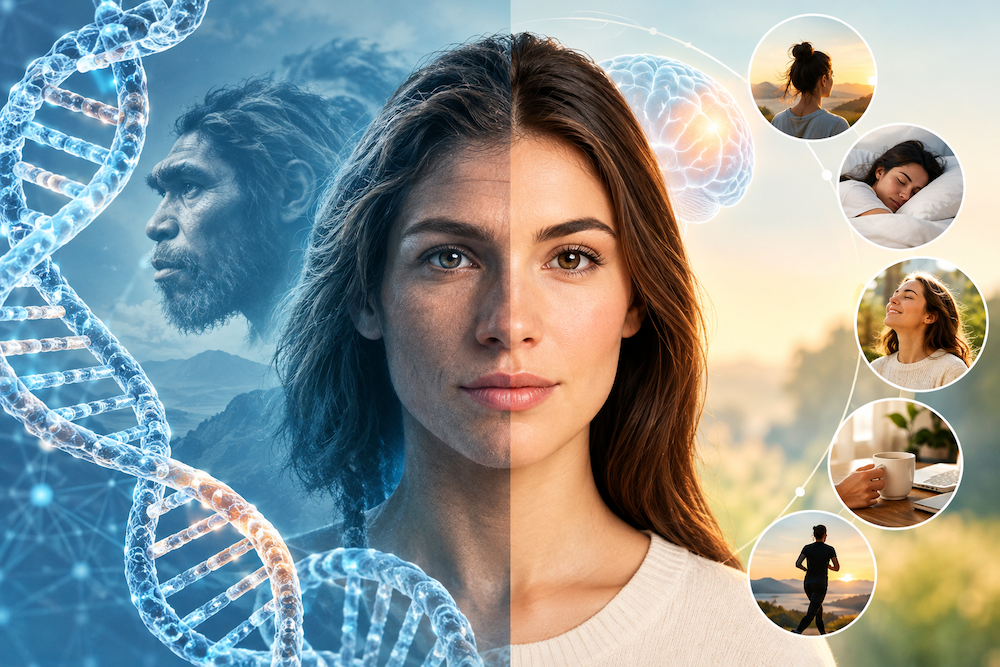
Why are some people naturally more active in the morning, while others function better in the evening? Why do we repeat certain behaviors without thinking, and why is it so difficult to break some of them?
The answer lies in the interaction between genetics, experience, and our environment.
Our genes can influence our biological predispositions, while habits develop through repeated behaviors. Together, these factors contribute to how we think, react, and organize our daily lives.
Modern research offers fascinating insights into this relationship, including the genetic inheritance we received from Neanderthals.
1. Neanderthal DNA: What Have We Inherited from Our Ancestors?
Human genetic history is more complex than we might imagine. Tens of thousands of years ago, modern humans interbred with Neanderthals, and fragments of their DNA became part of the genetic heritage passed down through generations.
Today, many people with ancestry outside Africa carry small fragments of Neanderthal DNA in their genomes.
But this inheritance is more than a reminder of our evolutionary past. Scientists are investigating how certain ancient genetic variants may influence characteristics in modern humans.
A study published in 2017 in The American Journal of Human Genetics, conducted by Michael Dannemann and Janet Kelso, analyzed data from more than 112,000 participants in the UK Biobank database.
The researchers identified associations between certain Neanderthal-derived genetic variants and characteristics such as:
- Skin and hair pigmentation.
- Certain sleep patterns.
- Mood-related traits.
- Smoking-related behavior.
These findings suggest that our evolutionary heritage may still contribute to biological and behavioral differences between people.
However, it is important to understand that a genetic association does not prove that a particular variant determines a behavior or personality trait.
Our genes carry traces of our evolutionary past, but they do not entirely determine our destiny.
2. Genetics and Behavior: How Much Does Our DNA Influence Us?
Imagine two people with different sleeping patterns. One naturally wakes up early, while the other feels more energetic in the evening.
This difference may be related to chronotype, the natural tendency to be more active at certain times of the day. Genetics can contribute to this characteristic, but it is not the only factor.
Age, stress, work schedules, light exposure, and lifestyle also influence our daily rhythms.
The same principle applies to other behaviors. A biological predisposition may make certain activities feel more natural to some people, but it does not mean others cannot develop them.
For example, if mornings are not your most productive time, you can adjust your exercise or work schedule to match the hours when you have more energy.
Understanding your own biological characteristics can help you build a realistic lifestyle instead of trying to follow someone else’s routine.
3. The Power of Habits: How Behaviors Become Automatic
Checking your phone in the morning, drinking coffee at the same time every day, or reaching for snacks when stressed are common examples.
The brain learns to associate certain situations with specific responses. As a result, we no longer need to consciously make every decision from scratch.
A useful model for understanding this process consists of three elements:
The Cue: The trigger that initiates a behavior, such as boredom, stress, a notification, or a particular time of day.
The Behavior: The actual response, such as checking your phone or eating a snack.
The Reward: The satisfaction you receive, which may involve entertainment, comfort, relaxation, or temporary stress relief.
For example, if you check your phone whenever you feel bored, the entertainment you receive may reinforce that response. Over time, boredom alone may automatically trigger the behavior.
This mechanism helps explain why certain habits are so persistent, even when we know they are not beneficial.
4. Why Is It So Difficult to Break Unwanted Habits?
Habits do not persist simply because we lack discipline or motivation. They are often reinforced by immediate rewards and the environment around us.
For example, scrolling through videos on your phone provides instant entertainment, while the benefits of better sleep take time to become noticeable.
Similarly, when we are tired or stressed, we tend to choose familiar behaviors because they require less effort.
This is why simply promising ourselves that we will change is not always enough.
A more effective approach is to identify the triggers behind our behavior and modify our environment:
- If you check your phone before bed, leave it in another room.
- If you eat out of boredom, find an alternative activity.
- If you keep postponing exercise, prepare your workout clothes in advance.
The idea is simple: make unwanted behaviors less accessible and healthier alternatives easier to follow.
5. Neuroplasticity: The Brain’s Ability to Change
One of the most fascinating characteristics of the human brain is its ability to adapt, a process known as neuroplasticity.
Through learning and experience, the nervous system can change its structure and function. Repeating an activity helps strengthen the processes involved in developing a skill or behavior.
This explains why an activity that initially feels difficult can become easier with practice.
Learning a new language, developing a professional skill, or establishing an exercise routine all involve repetition and adaptation.
However, there is no universal timeline for developing a habit. The process depends on the complexity of the behavior and the individual.
The key is to start small and focus on consistency rather than perfection.
6. Seven Strategies for Building Healthier Habits
Changing your behavior does not require radical transformations. A few simple adjustments can make a meaningful difference.
1. Start with small goals. If you want to exercise more, begin with ten minutes a day instead of committing to a demanding routine.
2. Connect new habits to existing ones. After your morning coffee, write down your priorities. After lunch, take a short walk.
3. Prepare your environment. Keep your workout clothes visible, prepare your meals in advance, or leave a book beside your bed.
4. Reduce temptations. Turn off unnecessary notifications and limit access to apps that distract you.
5. Identify your triggers. Notice when unwanted behaviors occur and what needs they are trying to satisfy.
6. Accept imperfection. If you miss a day, do not abandon your goal. Simply return to your routine without treating a temporary setback as failure.
7. Track your progress. A calendar or simple journal can help you monitor consistency and identify what works best.
7. Genetics and Habits: Two Influences That Work Together
Genetics and habits are not opposing forces. They constantly interact with our experiences and environment.
| Genetics | Habits |
|---|---|
| Represents inherited biological information | Represents learned behaviors |
| Can influence predispositions | Develop through repetition |
| Cannot generally be changed through willpower | Many behaviors can be modified |
| Interacts with the environment | Influenced by context and experience |
For example, genetics may contribute to our natural sleep preferences, but our daily schedules and evening routines also influence how we sleep.
Understanding this relationship helps us develop a more realistic perspective on human behavior. People do not all start with the same predispositions, but many can adapt their behaviors through practice and environmental changes.
Conclusion: Our Past Influences Us, but Our Future Is Shaped by Our Choices
Research into Neanderthal DNA reveals how deeply connected our evolutionary past is to the diversity of modern humans.
At the same time, research on habits demonstrates that our experiences and repeated behaviors play an important role in how we organize our lives.
We cannot change our genetic inheritance, but we can better understand our predispositions and consciously decide how to build our routines.
Our genes are part of our story, but our habits and daily choices help write the chapters that come next.
Scientific References
- Dannemann, M., & Kelso, J. (2017). The Contribution of Neanderthals to Phenotypic Variation in Modern Humans.The American Journal of Human Genetics, 101(4), 578–589. Read the study.
- Wood, W., & Rünger, D. (2016). Psychology of Habit. Annual Review of Psychology, 67, 289–314. Read the research review.
- Lally, P., van Jaarsveld, C. H. M., Potts, H. W. W., & Wardle, J. (2010). How are habits formed: Modelling habit formation in the real world. European Journal of Social Psychology, 40(6), 998–1009. Read the study.