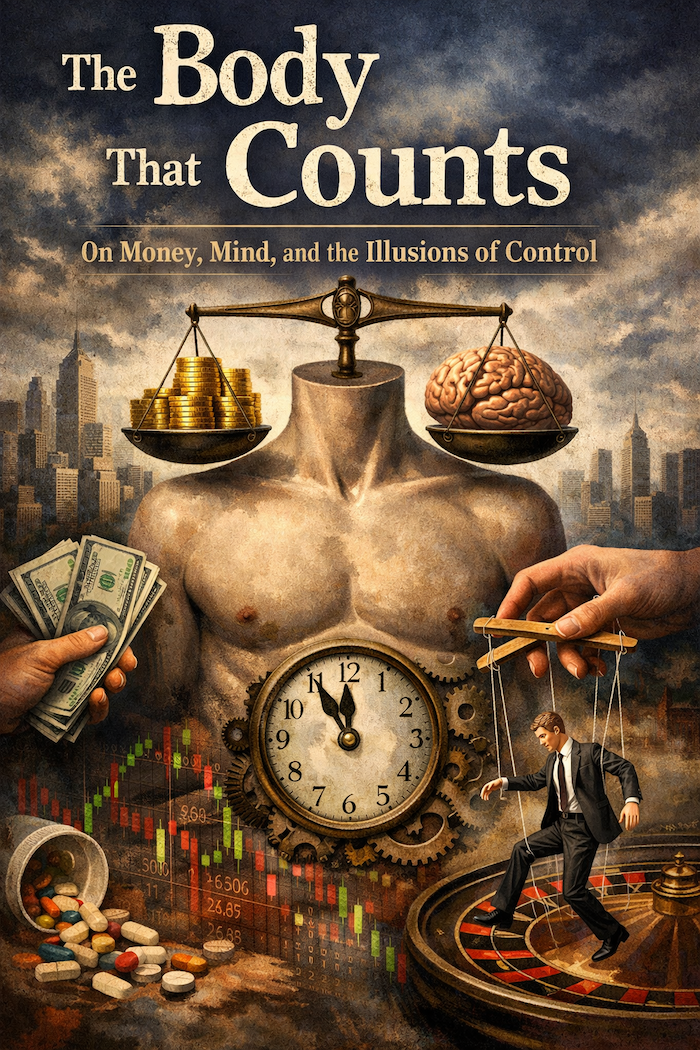
We live in a world where almost anything can be measured, monetized, reported. The steps we take, the calories we burn, the hours we are “productive”, the money in our accounts, ratings, likes. The body becomes a kind of biological calculator, constantly recording, comparing, evaluating. But what happens to the mind when everything turns into numbers? And what kind of illusion do these countings offer us, especially when it comes to money and the control we believe we have over our lives?
This article explores the relationship between body, money, and psychology, showing how the mind clings to numbers to feel safe – and how this need can turn into a subtle trap.
1. The body that counts: how we end up living in numbers
The human mind loves numbers. They are clear, seemingly objective, and give the impression of certainty. But before the mind calculates, the body calculates.
- You feel your stomach tightening when the money in your account goes down.
- Your heart rate increases when you see a minus on your bank statement.
- You feel a wave of heat or adrenaline when you receive unexpected money.
- Your sleep is disturbed when you think about loans, rent, debts.
The body counts in its own way: through heartbeat, muscle tension, shallow or deep breathing. Then the mind translates these sensations into stories: “I don’t have enough money”, “It’s going to be a disaster”, “I have to control everything”.
Financial numbers are, in fact, only a surface layer. Underneath them, an older accountant is constantly at work: your nervous system.
2. Money as symbol: it’s not (just) about amounts, but about meaning
Money is not just a means of exchange. Almost inevitably, it becomes an emotional and identity language.
For some, money means:
- Safety – “If I have money, I’m protected.”
- Personal worth – “If I earn a lot, it means I’m good, capable.”
- Freedom – “Money gives me the right to choose.”
- Love and recognition – “If I can provide, if I can impress, I will be loved.”
Thus, a number in the account becomes much more than a figure: it is a summary of how you see yourself and how you believe others see you. This is why financial changes activate the body so strongly: they don’t seem like mere changes of situation, but changes of identity.
From here, the pact with the illusion of control begins: “If I can control money, I can control everything: who I am, how I feel, how safe I am.”
3. The illusion of control: when numbers seem stronger than reality
The illusion of control is the tendency to believe that we have more influence over events than we actually do. Money is perhaps one of the most powerful arenas where this illusion manifests.
We tell ourselves:
- “If I make a perfect budget, my life will be predictable.”
- “If I put aside X amount, nothing serious can happen to me.”
- “If I reach income level Y, I’ll finally be at peace.”
Planning is healthy. The illusion is the belief that the world will follow our plan simply because we made it. The real world comes with:
- illnesses, accidents, losses;
- economic crises, inflation, changes in the job market;
- other people’s decisions, over which we have no control.
When reality doesn’t follow the script, the mind takes it personally: “I did something wrong, I didn’t control enough.” The body reacts with anxiety, shame, guilt. Instead of adapting, we blame ourselves or tense up even more: more control, more counting, more rigidity.
4. The accounting mind: when we become excessively control‑oriented
There is a part of us that we could call the accounting mind: the part that wants spreadsheets, lists, projections, simulations, reserves, scenarios.
This part has useful functions:
- it helps you keep track of expenses;
- it protects you from excessive debt;
- it helps you plan financial goals.
The problem appears when the accounting mind becomes the only perspective:
- people turn into “costs” and “investments”;
- time with loved ones is judged in terms of “productivity”;
- rest becomes a “waste of time”, not regeneration;
- everything is measured in “worth it / not worth it”, “what it brings / what it doesn’t bring”.
In this state, the body chronically enters alert or fight mode: tension, restlessness, constant worries. We no longer live life; we only monitor it. We no longer feel; we only calculate.
5. When the body begins to protest
Often, the signal that the illusion of control has gone too far doesn’t come from the bank account, but from the body.
Common signs:
- Sleep disturbances – you fall asleep with difficulty, you wake up at night thinking about money, projects, loans.
- Chronic muscle tension – tight shoulders, clenched jaw, back pain.
- Digestive issues – tight stomach, heartburn, lack of appetite or compulsive eating.
- Irritability and fatigue – any small financial or professional deviation destabilizes you disproportionately.
- Difficulty being present – you are with loved ones, but your mind is on numbers, charts, calculations.
The body is speaking, in a very direct language: “I can’t carry this level of control anymore. I need you to lower your guard a bit.” But the accounting mind interprets this as weakness and, paradoxically, pushes the accelerator even harder.
6. Why we love control, even when it hurts us
Psychologically, the need for control is, at its core, a need for safety. When the world is unpredictable, the mind looks for a fixed point. Money seems to be one of the few things that can be quantified, therefore “solid”.
The roots can be:
- Early experiences of insecurity – material shortages, parents anxious about money, instability.
- Cultural messages – “If you don’t have money, you’re worth nothing.”, “You must always have more to be safe.”
- Fear of dependence – money as a form of total autonomy, as a shield against needing other people.
Financial control becomes, therefore, a coping strategy: “If I keep everything under control, I won’t feel fear anymore.” The illusion is that fear disappears through total control. In reality, fear only moves: from “I have nothing” to “I can lose everything”.
7. The freedom of not controlling everything: another form of intelligence
The antidote is not financial chaos, carelessness, or “it’ll sort itself out somehow”. We’re not talking about throwing away discipline, planning, responsibility. We’re talking about recognizing the limits of control and leaving room for flexibility, adaptation, and trust.
A few perspective shifts:
- From total control to limited influence
- From numbers as identity to numbers as tool
Instead of: “I must control everything related to money,” You can move to: “I can influence some things (spending, saving, the way I earn), but I cannot control the economy, other people’s decisions, the future.”Money becomes a tool in your life, not a measure of your worth. When the number in your account goes down, your human value remains the same. When the number goes up, you don’t suddenly become more “worthy” of love.
- From rigidity to multiple scenarios
Instead of a single ideal scenario (“Only this way is good”), you accept several possible options: plan A, B, C. This reduces the shock when reality doesn’t follow the plan.
8. Concrete practices for stepping out of the illusion of control
So that all this doesn’t remain just theory, here are a few practical directions:
8.1. Notice your body when you think about money
- Sit down for a few minutes and bring to mind a real financial situation (a debt, a loan payment, a goal).
- Observe: where do you feel tension? How are you breathing? What is happening in your stomach, chest, throat?
- Don’t try to “solve” anything. Just become aware.
This gently separates the body from the mental story and weakens the automatic chain “thought – panic – control”.
8.2. Distinguish between “healthy control” and “obsession”
Ask yourself:
- “Does this financial action (checking my balance, recalculating the budget, redoing the spreadsheets) actually help me, or does it just soothe my anxiety for a moment?”
- “If I didn’t do this right now, what would happen concretely? Is there a real consequence or just a fear?”
If the honest answer is that nothing serious would happen, but you still feel enormous pressure to “check one more time”, you may already be on the territory of the illusion of control.
8.3. Deliberately introduce small doses of “uncontrolled”
Contrary to how it may seem, practicing a bit of discomfort makes you stronger:
- Don’t check your banking app for a day or two.
- Allow a small expense that wasn’t “calculated in advance”, but is consciously chosen.
- Accept that you don’t know exactly what your financial situation will look like in 5 years – and still live, love, and enjoy today.
This isn’t recklessness, but training in tolerance for uncertainty.
8.4. Work with your core beliefs about money
Write down beliefs like:
- “Without money, I don’t exist.”
- “People with money are…”
- “If I don’t earn enough, I’m a failure.”
Then ask:
- “Who passed this on to me?”
- “Is it always true? Can I find examples that contradict this idea?”
- “How do I feel and behave when I believe this? Does it help me or block me?”
Real change happens not only when you manage your money differently, but when you see your relationship with money differently.
9. From the body that counts to the body that lives
In the end, the essential question is not just “How much money do I have?”, but “How do I live, while I am counting?”
- Can I feel pleasure, presence, connection with others, whether I’m in a phase of accumulation or of loss?
- Can I sometimes let numbers be just numbers, without immediately turning them into judgments about who I am?
- Can I accept that a part of life will always remain unpredictable – and that precisely there lie mystery, creativity, spontaneity?
The body that counts needs, from time to time, to also become the body that breathes, the body that feels, the body that plays. Money remains important, financial vision remains useful, prudence remains necessary. But true maturity appears when you no longer confuse the amount in your account with the amount of your life. In essence:
- Money is made of numbers, but for the mind it becomes stories about safety, worth, and control.
- The illusion of control appears when you believe that, by managing numbers perfectly, you can control life as a whole.
- Freedom does not mean ignoring money, but placing it back in its proper place: tools of life, not its masters.