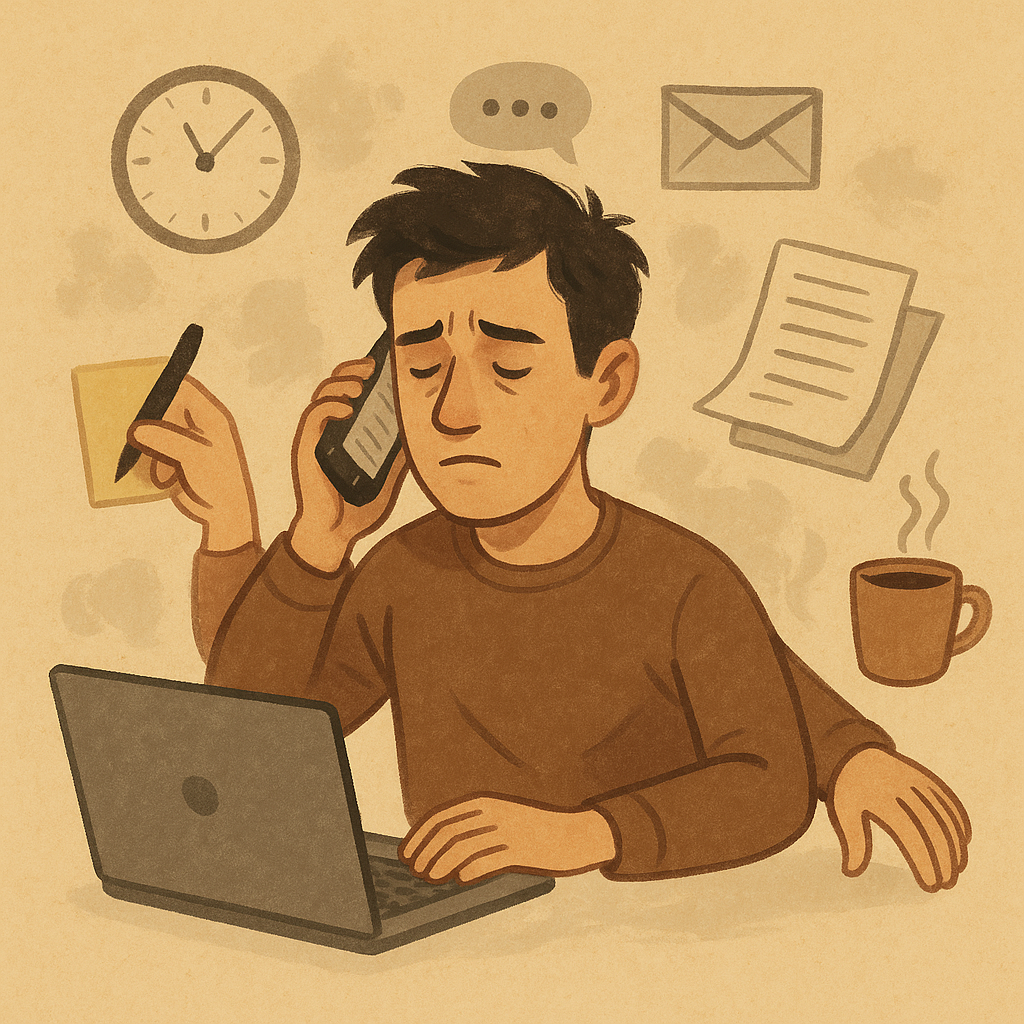
In today’s fast-paced, hyper-connected world, multitasking has become a so-called “superpower” that many of us rely on daily. We try to respond to emails while attending online meetings, check our phones while eating, or hold conversations while mentally listing everything we still have to do. Sound familiar?
But what really happens when we try to do multiple things at once? What are the invisible, often overlooked effects of being “everywhere and nowhere” at the same time?
The Illusion of Productivity: A Multitasking Paradox
Many of us believe that multitasking makes us more productive—that it helps us check more tasks off the list in less time. But cognitive studies suggest otherwise: our brains aren’t built to process multiple complex activities at once. What we’re really doing is switching our attention rapidly from one task to another, and this “task switching” decreases efficiency and increases errors.
In the short term, it may seem like we’re moving faster, but over time, multitasking can lead to mental exhaustion and a deep sense of inefficiency.
Fragmented Presence: When Your Mind Isn’t Really There
One of the most subtle effects of multitasking is the loss of genuine presence. When you try to do everything at once, you’re not truly present anywhere—not at work, not with family, not even during your downtime. Your mind is split, and the feeling of truly “living the moment” quietly fades away.
This fragmentation impacts relationships, creativity, and the ability to connect with your own emotions and needs. Always being “on the go,” thinking about the next task, means missing the essential moments of life.
Invisible Stress and the Risk of Burnout
As we push our brains to constantly handle a continuous flow of stimuli and tasks, our stress levels quietly rise. Even if we don’t immediately realize it, constant multitasking can lead to mental and emotional exhaustion—also known as burnout.
This state doesn’t just impact your work performance; it also affects your overall well-being: sleep, immunity, emotional balance, and personal relationships all begin to suffer.
How to Escape the Multitasking Trap
The first step is awareness—understanding that multitasking isn’t a sign of efficiency, but a barrier to it. To protect our time and energy, we can start by prioritizing tasks and giving full attention to each moment.
Practicing mindfulness, taking regular breaks, and organizing tasks clearly can help us reconnect with our presence. That way, not only do we work better—we live more authentically.
Multitasking makes us feel like we’re doing a lot, but in reality, we risk never truly being present. Letting go of this invisible habit may be the key to a more balanced, productive, and fulfilling life.